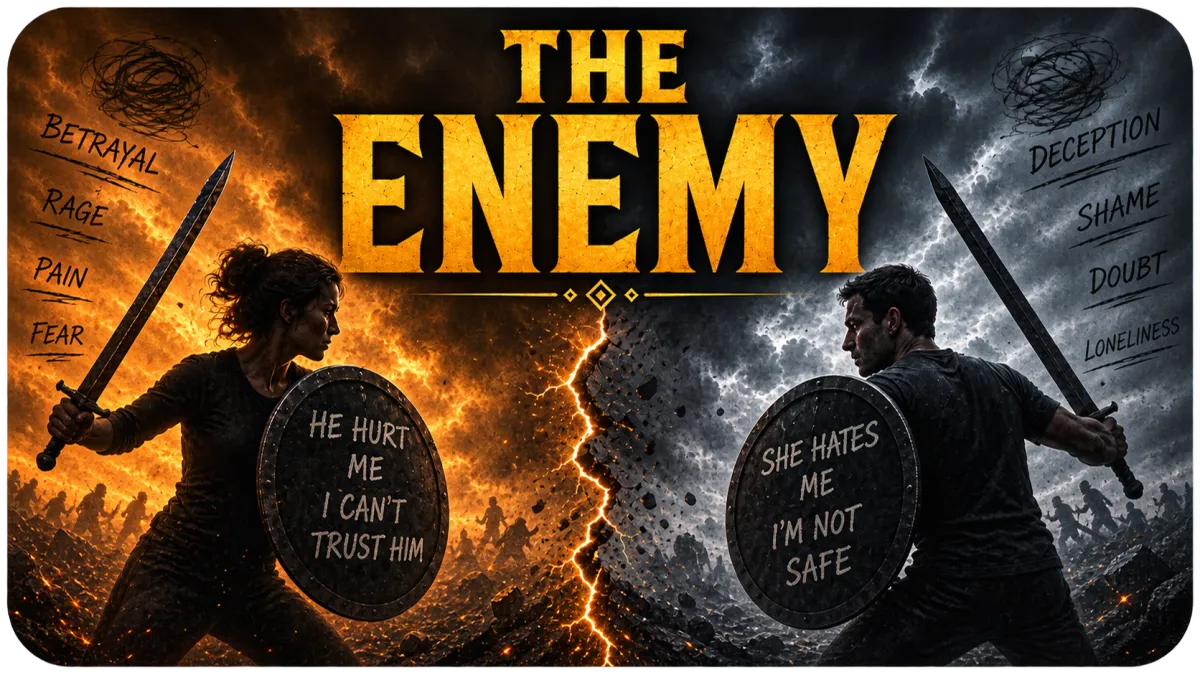
The Enemy
"Outside of the death of a loved one, there are very few life experiences that compare to this depth of pain, or this difficulty of recovery."
The Enemy
Let's talk about something hard today.
How do you talk to a room full of women who have all been betrayed by their partner, about why it's not going to help them to see him as the enemy? (and live to post another day😅)
That is exactly what I'm attempting to do today.
As with anything this sensitive, we need to start with why it makes sense that you are seeing him that way.
He was supposed to be the one you could count on. The one you trusted with your most vulnerable moments. The one you could be fully authentic with, safe with, protected by, emotionally close to.
The one you went to for a hug when things hurt the most, and found comfort there when inside his embrace.
The one you shared the most sacred, private, intimate parts of yourself with...
And he violated all of it.
Threw it in the trash as if that gift was worthless.
And then for so many of you, you were left alone in the aftermath.
Picking up the pieces of yourself by yourself, because he had no idea what to do, so he did nothing. That aloneness is horrifying on its own.
Then add another layer of isolation on top of it. Because it can feel like no one truly understands or knows how to help.
And because this is addiction we're talking about, not a single lapse in judgment or one traumatic event, this becomes complex trauma. More discoveries. More betrayals. Piling onto a mountain of pain that was already unimaginable.
For any woman to survive this is truly a miracle.
Outside of the death of a loved one, there are very few life experiences that compare to this depth of pain, or this difficulty of recovery.
So what do we do with all of that?
The most logical thing for the brain to do is move into protection.
Make sure this never happens again.
And when we protect something, we fight. When we fight, we need an enemy to aim that fight at.
He's the one who made these decisions, so it's a perfectly reasonable place to land: he is the enemy. He is to blame.
For some women, the opposite actually happens.
This was me, in my previous relationship. Instead of making him the enemy, we make ourselves the enemy.
We internalize the experience as proof of what we already believed. That we were never deserving of being chosen. That we were never good enough. That we were destined to be unloved. That we need to fix ourselves enough to be loveable.
"Look at me. Who could blame him?" we say to ourselves.
Both of these extremes feel safer to our nervous system than anything else, because we desperately need some kind of meaning to make out of what happened to us, and some sort of control over what happens next.
If we blame him, we can direct our anger at the problem outside of us. That gives a sense of control.
If we blame ourselves, we can direct that same anger inward, because now we're the problem to solve. That feels like control too.
But both of these create a new problem.
Getting better at building the case against him doesn't get you unstuck.
Getting better at protecting yourself from him doesn't get you unstuck.
Getting better at pointing out all of your flaws doesn't get you unstuck.
Getting better at hating yourself doesn't get you unstuck.
None of these move you an inch closer to whatever it is you actually want.
We can't hate our way into a relationship of love and connection.
Not with someone else, and not with ourselves.
And we can't even see whether that's possible when all we're holding are shields and arrows.
We need different tools.
That doesn't mean no longer having any anger or pain.
That doesn't mean deciding you're staying in the relationship.
That doesn't mean giving compassion without reciprocation.
That doesn't mean making yourself vulnerable to more pain by trusting him before you're ready.
That doesn't mean excusing what happened, or rushing yourself past what you feel.
That doesn't mean you're to blame, or this is your job to fix alone.
What it means is learning how to slow down enough to see another way.
Learning what each of your nervous systems has been trying to say, for a very long time.
Learning how to get those deep wounds actually seen and felt by your partner, or learning whether that's even possible.
Learning how to see his experiences, wounds, and needs too, without discounting them because of your own.
It's so easy to decide he doesn't have a right to have needs right now. But that decision won't actually create change.
Because when two nervous systems feel unsafe, they keep returning to the sources of comfort they've learned feel safest.
Trust doesn't come back through better arguments. Better bullet points. More proof you're right.
It comes back through a nervous system that finally feels safe.
So to create a new trajectory, we have to carve out a new path.
One where your nervous systems can actually find their way toward each other, instead of away.
You can try it the old way, on a different day, about a different topic.
But the moment something you say lands sideways and he shuts down or gets defensive, and that triggers you to feel unsafe and unheard again, the same cycle just picks up where it left off.
Without learning how to find that new path, there's no door to repair.
And without the door, you never even get the chance to make a real decision about whether healing together is possible for you.
That decision deserves to be yours to make. But you can't make it from inside the same old fight.
If this is resonating and you're ready to find that door, comment DOOR below along with your email, and we'll send you what that next step can look like.
