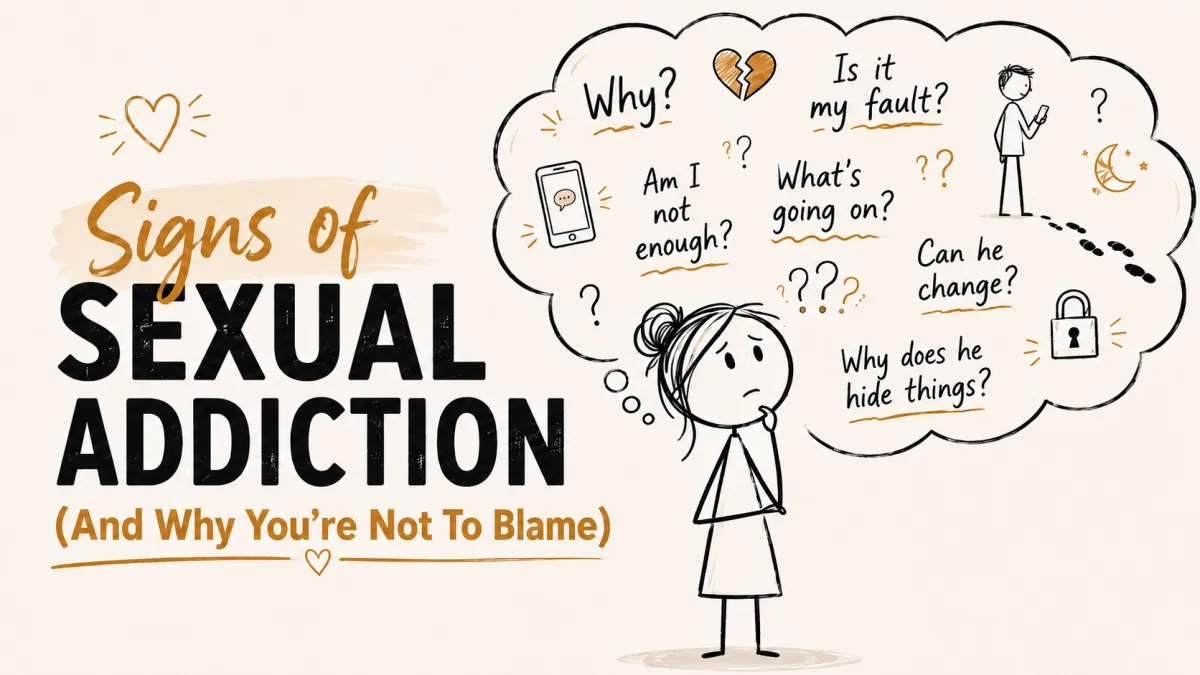
Signs of Sexual Addiction (And Why You're Not To Blame)
"She is now competing with a survival strategy that existed long before she arrived. And one that she can never win against, so long as he continues to feed it."
Signs of Sexual Addiction (And Why You're Not To Blame)
Behavioural Patterns
Frequent masturbation
Regular and frequent porn use
Increasing consumption of more novel or extreme sexual content
Following large numbers of sexualized social media accounts
Flirting for validation
Emotional affairs
Physical affairs
Sexting or hidden online relationships
Secret dating profiles
OnlyFans, cam sites, paid sexual services
Secret accounts or devices
Staying up late, waking up early or getting up in the middle of the night to be alone and engage in sexual behaviour
Disappearing into bathrooms, offices, garages, or other private spaces for sexual behavior
Excessive time spent on his phone or computer
Clearing browser history
Hidden apps or disappearing messages
Protectiveness around devices
Repeated promises to stop followed by relapse
Sexual behaviour increases during stress
Emotional Patterns
Uses sex after arguments
Uses pornography after feeling rejected
Uses masturbation when anxious
Uses novelty when bored
Difficulty sitting with uncomfortable emotions
Emotional withdrawal after orgasm
Difficulty sustaining emotional intimacy
Craves excitement but avoids vulnerability
Difficulty expressing feelings
Low frustration tolerance
Shame after acting out
Behaviour temporarily relieves stress and anxiety
Relationship Patterns
Gaslights or lies when questioned
Minimizes concerns
Blames you
Says you're insecure, controlling, jealous or crazy
Defensiveness replaces curiosity
Lack of safety between partners
Crossed boundaries
Less present emotionally
Sex becomes less connected
Trouble staying erect or finishing with their real life partner
Partner feels lonely despite being in a relationship
Partner constantly questions herself
Brain & Nervous System Clues
Novelty matters more than connection
Escalation over time
Temporary relief followed by guilt
Shame fuels another cycle
Easy dopamine becomes the go-to for emotional regulation
Behaviour continues despite consequences
Behaviour interferes with work or relationships
Unable to stop despite genuine intentions
Why do sexual addictions develop?
The brain is brilliantly adaptive. It doesn't care whether a strategy is healthy. It cares whether it works. If sexual stimulation reliably reduces anxiety, numbs shame, interrupts loneliness, distracts from emotional pain, or provides temporary relief from unresolved trauma, the brain remembers.
Every repetition strengthens the pathway until eventually it stops feeling like a choice and starts feeling like the fastest route back to emotional equilibrium.
And for the majority of men in this place, the average exposure started around age 9, when their brain was going through the most fundamental stages of development.
Women usually don't discover one dramatic event. They discover hundreds of tiny inconsistencies that slowly accumulate into a picture they can no longer ignore.
They notice that even though they're having regular sx, he still msturbates constantly. He follows hundreds of sexualized accounts online, spends hours scrolling, searches for increasingly novel content, and somehow still seems restless.
In time, the need for novelty escalates beyond a screen into emotional affairs, sexting, secret conversations, paid content, or physical infidelity.
The relationship itself may not be severely necessarily lacking. His nervous system has simply learned that novelty produces a faster dopamine response than familiarity and he doesn't have the self awareness or skills yet developed to feel what he is really feeling, so his brain turns to the survival response.
Then they notice the phone.
It never leaves his hand. It goes into the bathroom, it sits face down on the table. Screens change the moment someone walks into the room. Browser histories disappear, passwords suddenly become private. There are hidden folders, disappearing messages, unexplained accounts, and an emotional attachment to the device that feels strangely disproportionate.
The phone has quietly become an endless delivery system for novelty, validation, fantasy, and dopamine.
The nights begin to feel different too.
He suddenly struggles to sleep, you wake up and he's gone. He's downstairs, in the office, in the spare room, sitting in the garage, or hiding in the bathroom with the door locked. Sometimes there are innocent explanations, mostly there aren't.
Survival strategies rarely enjoy being witnessed. Shame prefers privacy, and the brain quickly learns to associate secrecy with relief.
Eventually you ask a question, because your intuition has collected too many pieces that don't fit together.
At the start, the response is rarely compassion. Your questions are a threat to his nervous system. A threat of being exposed and rejected. Of feeling ashamed for this part of him he doesn't know how to let go of.
So instead of vulnerability, you're told lies.
You're imagining things. You're insecure, jealous, controlling. You're making a mountain out of nothing. Somehow the conversation quietly shifts away from his behavior and onto your emotional reaction. You leave doubting your own perception while the original question remains unanswered.
Over time another pattern begins to emerge.
As the realization comes that this is something he can't stop, the dopamine fades, shame appears, promises are made. He genuinely believes this time will be different.
Then another stressful day arrives, another difficult emotion surfaces, and the same pathway lights up all over again.
The shame created by the behavior becomes another reason to repeat the behavior. The nervous system becomes trapped inside a loop that it mistakes for safety.
Meanwhile, something equally painful happens to the woman. She starts believing the problem must somehow be her.
She wonders if she's attractive enough, adventurous enough, young enough, available enough, or desirable enough.
She tries harder. She becomes more accommodating. She works endlessly to become someone she should never become - one real life human attempting to compete with a super stimulus and millions of other women.
She is now competing with a survival strategy that existed long before she arrived. And one that she can never win against, so long as he continues to feed it.
Understanding that doesn't excuse lying. It doesn't excuse deception, betrayal, or broken trust. Every adult remains responsible for the impact of their behavior. Explaining the neurobiology isn't the same as removing accountability.
But for those ladies who are suffering because they question what's wrong with him, or even, what's wrong with him? This isn't something wrong with either of you innately.
But there IS a lot here that is very wrong.
There is something wrong with the way this industry targeted him and knew how to make him a life long consumer. How this hijacked his brain before he even had a chance to decide for himself if this was what he would choose. The way no one taught him the impact of this on his ability to experience real love, attachment and sexual fulfillment with his future partner. The way our society normalized this for him as a harmless preference, and something "all guys" to do.
So if you're a betrayed partner, do not ask "Why am I not enough?"
Ask, "Is he willing to learn what has really happend in his life that led to this point of his brain living in patterns of escape and do the work it will take to heal trauma and dysregulation? Does he care enough about having a real relationship with me, that he'll get the help necessary to actually change this?"
That is where recovery can begin.
And you can make decisions based on real data, not just emotional overwhelm.
