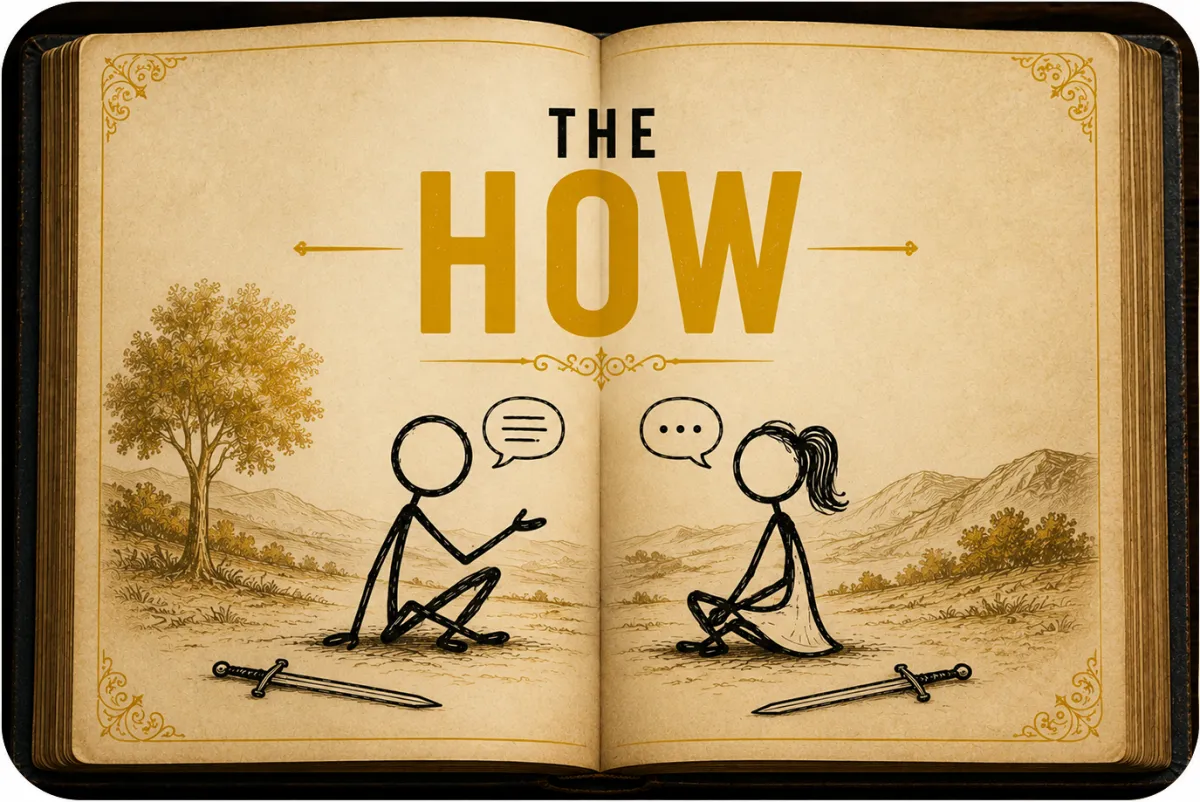
The "How" (From Wall #6)
“We cannot keep running the same system and expect it to produce a different result.”
The "How"
Picking up where we left off from breaking through the wall of the"Tale of Two Competing Truths", we're going to discuss the "how".
How do two nervous systems that have been stuck in protection mode ever find their way back to each other?
How do you get understood in your pain, when every attempt to explain it lands as an attack instead?
Before we get anywhere near the how, let's start with what it actually feels like for the betrayed partner from the inside.
When we aren't understood in our pain, we are alone.
And when we're alone, we do the only thing that's ever made sense to us: we try to make him see it. We tell him every reason what he's doing is the problem, hoping he'll finally look past the anger and the tears and the panic, and see the hurt and fear underneath. Hoping he'll finally care for it.
And when he can't hear us, when he shuts down or gets defensive instead, we feel even more alone than before we ever opened our mouth.
So we try harder.
We build the case. The perfect words.
Hundreds of imagined conversations, rehearsed until they're flawless; our mental fine-tuned PowerPoint, our dry-erase storyboard presentation... ready for the moment he'll finally get it.
Surely if we say it right, this time, he'll see how right we are.
We're trying. So incredibly hard.
We're not walking out the door, even when everyone around us thinks we should.
We're not being a doormat. We're not "just being avoidant" by shutting down.
We're fighting and kicking and screaming because we are trying — trying to be heard, trying to make the pain visible enough that he'll finally have to look at it.
But when the perfect presentation doesn't land the way we needed it to, the thoughts get louder.
"If he wanted to, he would."
"He doesn't really love me, or he'd hear this."
"Maybe I'm just an enabler."
"Maybe if I set the boundary, 'change, or I'm gone', that's what will make him finally get it."
Anything to make the ache make sense.
Because we are desperate to not sink into the dark hole of believing that there's no hope.
We don't want to lose him. We don't want to give up on us.
So we come back. Same fight. Same rumination. Same imagined conversation, slightly revised.
We talk ourselves off the ledge - only to find ourselves standing on the edge of it again a week later.
Here's the truth underneath all of it:
We can only change these cycles when we're willing to fully admit, this isn't working. Neither of us knows what we're doing.
We cannot keep running the same system and expect it to produce a different result.
So here's the wrench. And to see it work, you'll need to be courageous enough to throw it into the system... even when it feels really scary.
The cycle breaks the moment we stop showing up in ways that make our partner the problem to fix. The enemy to win against. The child to scold. The punching bag for our anger.
The one with no excuse, who should have known better, who isn't allowed to have fears or confusion or questions of his own.
We create something new only when we do something different.
Less words.
More eye contact.
More slowing down.
We start seeing each other as what we actually are: imperfect, lost, messy, wounded, complicated, still-figuring-it-out humans.
We sit together in that reality. We let our nervous systems speak to each other, instead of our arguments.
For that to actually happen, we need to find an in.
An in where our nervous systems can begin to speak.
Not a better argument. Not a sharper case. The opposite.
It's a softening.
It's trading the dry erase board for vulnerability and humility.
It's the moment we stop pointing at his behaviors - what he did, what he didn't do, what he should have done - and start sharing what's actually happening inside of us instead.
When we share what's underneath, something else becomes possible: we get to peek out from behind our own shield of protection. And slowly, carefully, start moving toward the other person instead of away.
Here's the part that changes everything.
The aim of this conversation ISN'T to fix the problem. It's to be IN the problem, together.
It's not about getting him to finally admit we were right. Or him getting us to finally admit we are wrong.
It's about showing the other person's nervous system,you aren't in danger with me. Your vulnerability won't be punished here. I won't reject you. That honesty, and the messy emotion underneath it, is safe to bring into the room.
Admitting we have no idea what the hell we're doing?
That's a great place to start.
Not "You're doing this wrong and this wrong, and here's all the evidence."
Just: "I'm scared. I'm hurting. And I feel alone in that."
That's the in.
The softening on the face. The touch of the hand. The reach that says, "I'm in this with you. I'm not against you."
That's the beginning of two nervous systems finding each other again.
As you read this, what questions came up for you about breaking the cycle?
Drop them below. I'd love to know where you're getting stuck.
