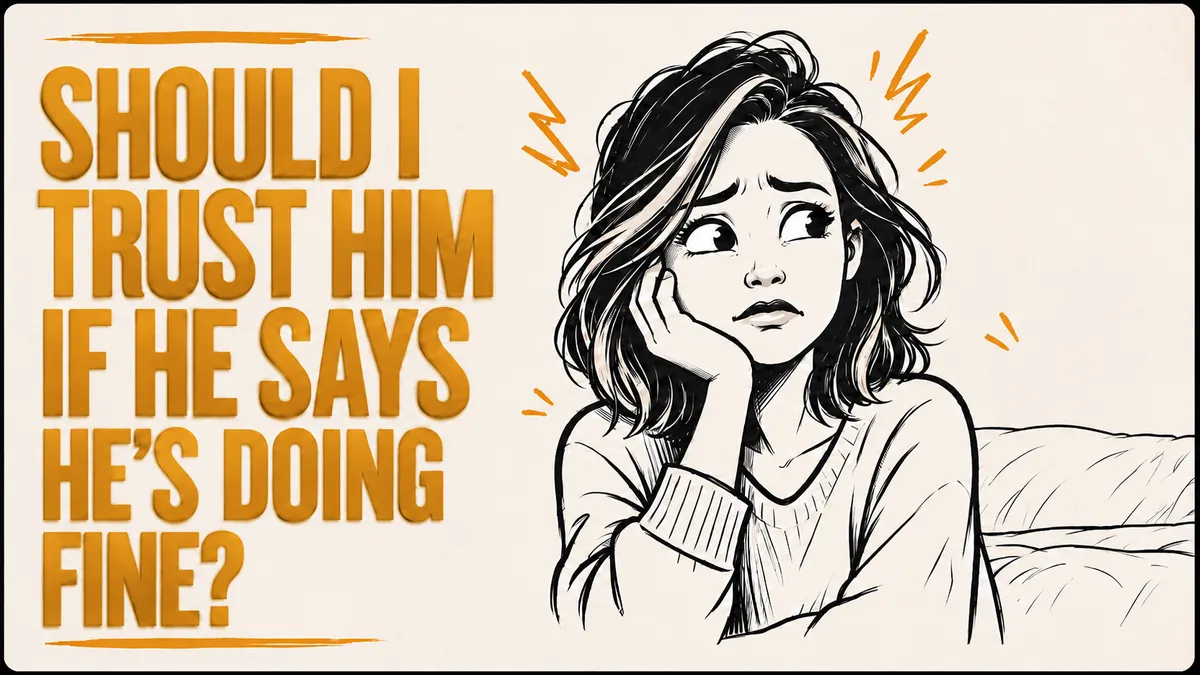
Should I Trust Him If He Says He's Doing Fine?
“When you don't know what you don't know, it's really easy to believe this is a you problem. Or that if he's telling you he's good, you must just need to stop feeling anxious and trust him.
Either way, you end up teaching your own nervous system it can't be trusted.”
Should I Trust Him If He Says He's Doing Fine?
He says he's stopped and he's not struggling. Now it's on you to just trust him.
He's going to therapy and listening to the podcasts. So you're supposed to feel safe now.
It's been decided that once he says the apology, gets into a room with a therapist, opens a book, joins the groups, then the debt is paid.
And in each of these situations, if you still flinch, still check, still can't relax around him, somehow you're the one who's behind now.
You're the one who needs to be fixed.
His therapist might even say you need counseling.
And maybe you do. Everyone benefits from support. But not because you're the problem.
That's the myth.
His genuine effort isn't the equivalent of a magic eraser, and something isn't wrong with you if you're still hurting and questioning your reality.
You need support because you are the one left holding a nervous system that watched everything you believed was real, your entire existence, shatter into a million pieces.
And it's uncomfortable for everyone involved to see that level of pain and not know what the hell to do with it. So then it's put back on you.
But...
He's in therapy.
He's in a support group.
He's going to Bible study.
He's reading the books.
He's listening to the podcasts.
He says he's stopped.
What more should I expect of him?
Isn't it on me now?
Here's the truth that makes people uncomfortable: none of this takes a process from chapter 0 to chapter 20.
A process can't be skipped just because you bought the book.
Each of these things, as helpful as they are, only hands you a few scattered pieces, never the whole picture, and never the instructions for how they fit together.
Most couples don't even have the picture on the box to know what they're piecing together in the first place.
Even in the best case, where he really has stopped (and real stopping almost always comes with struggle and setbacks he's learning from along the way, not a clean, instant fix), here's what's still true:
Abstinence ≠ recovery.
Abstinence doesn't repair a relationship from betrayal.
Abstinence doesn't rewire decades of repetition that changed how the brain's reward pathways operate.
Abstinence doesn't teach his nervous system to actually attune to yours, in real time, without you exhausting every way you know how to say it, or ask it, just so the pain finally lands or the truth finally surfaces.
Abstinence doesn't create the craving for closeness that teaches his system what sexual reward and fulfillment can actually feel like.
So until you've got the understanding, the information, and the practice, what's happening is you haven't read all the chapters yet.
And that's not because you're failing. It's because you were never given all the pages to begin with.
And you can't read the next chapter of a book you don't have all the pages to.
Not because the two of you aren't highly intelligent.
Not because you can't forgive and move on.
Not because trusting him again isn't possible.
And not because he doesn't actually want recovery.
Not for any of those reasons.
It's because what actually rewires the brain and repairs a relationship after betrayal has never been laid out clearly for either of you.
And unfortunately, very few sources of help understand the importance of doing things this way.
Many couples are told to do the work individually, and to leave the other person alone to figure themselves out, or else they're being "codependent."
This is an old model, and it's extremely harmful advice. It doesn't work. It won't help a couple connect or heal together, not even a little.
Real recovery isn't a to-do list he completes alone while you wait for your hero to finally emerge.
And it's not you going out to get help because you're broken and can't seem to self-regulate.
Real recovery is understanding what's going on underneath all of these things, together.
Caring for what's going on for him. Caring for what's going on for you.
Learning the patterns, traumas, responses, and triggers. Not just so you can explain it, but so you can actually bring all the things that have been silently running your lives to the surface, and change what's no longer serving you.
It's daily internal work, on both sides. Catching automatic thoughts. Interrupting old patterns on purpose, over and over, as often and as long as it takes.
It's building real emotional connection to what this did. To him. To you. To your life together. Not an apology. Not an explanation. An actual felt understanding of what this has cost you, and what it's still costing you.
It's evaluating belief systems that have been playing quietly in the background for years, the ones that made this possible in the first place, and are still running right now if nobody's noticed them.
It's nervous system work, together. Not just him fixing himself in isolation while you try to wait patiently, but the two of you learning to co-regulate and slow down instead of triggering each other back into old patterns.
It's attunement. Real attunement. The kind where he notices you shift before you say a word, because he's finally paying attention, and it actually matters to him what just happened inside you.
And these poetic, carefully constructed words for a catchy Facebook post I'm writing for you? They're really just scratching the surface.
I spend this time writing these things because I'm desperate to use what I've gone through to help you. Hoping something here reaches you before the trauma builds as bad as it did in my own relationship, or as bad as it's gotten for so many others who finally became too overwhelmed to keep going.
When you don't know what you don't know, it's really easy to believe this is a you problem. Or that if he's telling you he's good, you must just need to stop feeling anxious and trust him.
You either don't feel safe and try to convince yourself you should, or you naively think you are safe and can easily end up blindsided.
Either way, you end up teaching your own nervous system it can't be trusted.
If you're not feeling safe right now, you're not crazy or behind.
You were just never given a map, and neither was he. Neither of you probably even realized you'd need one.
Imagine you live where I do, in Pittsburgh, PA, and decided you wanted to visit Antigua.
So you packed a bag with as much food and water as would fit, bought good shoes, and started walking, hoping you'd figure out the route as you went.
What you didn't know: to walk there you'd head southeast out of the city, pick up a trail across the Appalachian Mountains into Maryland, follow a canal path into Washington, D.C., then continue south through Virginia, the Carolinas, and Georgia, all the way down the length of Florida to Key West.
And then you'd hit a dead end. Because Antigua is an island, surrounded by open ocean. From there, walking isn't even an option anymore. You'd need a boat, over a thousand nautical miles of open water, past the Bahamas, past the Dominican Republic, before you'd ever drop anchor.
That's pretty much what it's like to try this without a map. Not because you're not capable. Because no one ever showed you it was a completely different kind of journey than the one you thought you were on.
Here's what's real. The longer you both go without a guided path, the longer this stays this impossibly hard.
It's not going to become easy. I won't tell you that it will. Even with the right map, every piece given to you, the picture laid out, the chapters written, this is still going to be one of the hardest things you ever walk through.
But there is real hope here. You can cut years off this journey, and with it, very likely years of traumatic, overwhelming, and damaging experiences you don't have to go through to get there.
The sooner you both get real help, the sooner you can feel confident about the process, and clear about exactly where you're at inside of it.
You don't need to be told there's something wrong with you, or that this is your work to do alone.
You need both of you to finally know what you're actually building toward, and what the people who've walked this road before you have already learned about how to get there.
If you'd like to learn more about the couples-centered recovery course we offer, Relationship Rebuild, type the word 'map' below. 👇
We've got several levels of support, ranging from self-directed work to private coaching.
Everyone who comments will get a private message from me with a special offer: a free 1:1 session with one of our coaches, included if you sign up for the course.
